
Haemoglobin
Measuring Haemoglobin supports clinical assessment of full blood count and can help identify patterns consistent with dysfunction or active disease processes.
Booking product
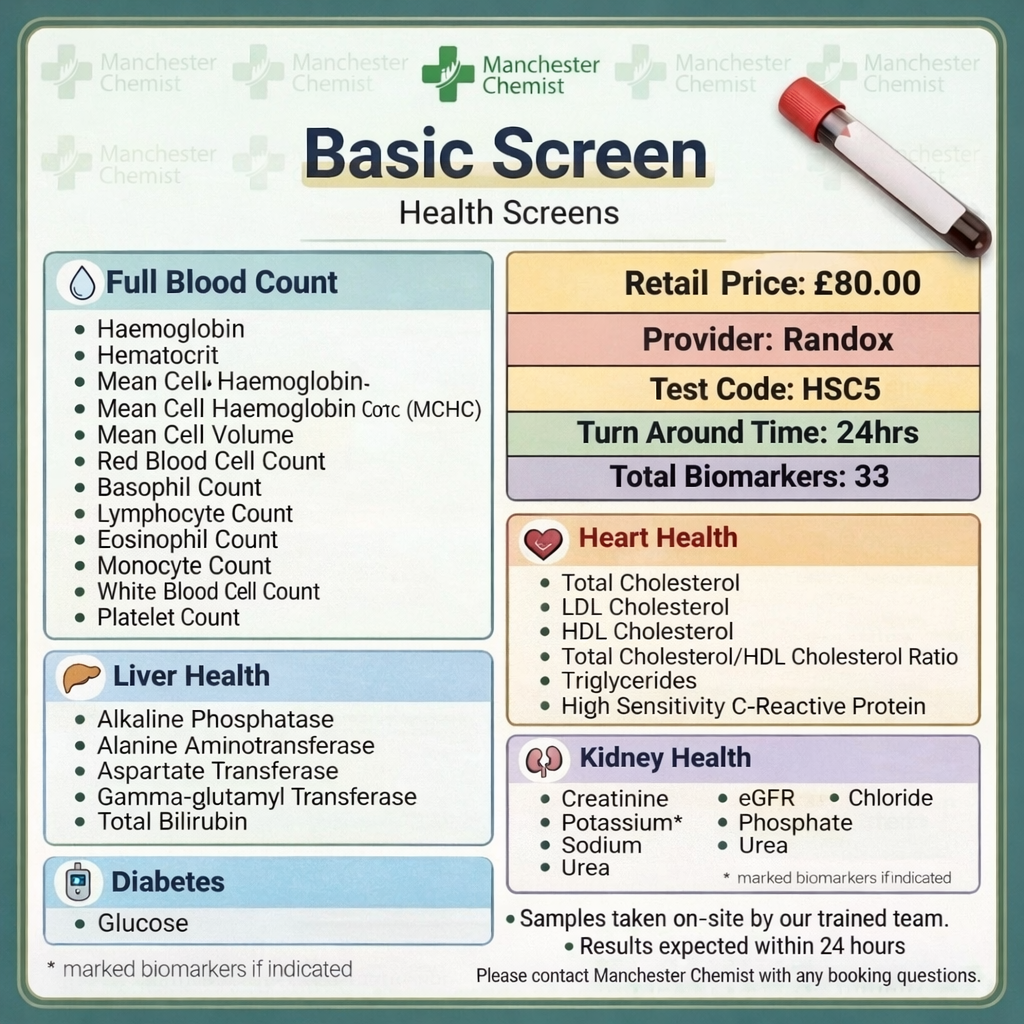
Basic Screen is a private blood test available at Manchester Chemist. It includes 33 biomarkers, processed by Randox, an expected turnaround time of 24hrs, test code HSC5, and prices from £80.This panel is designed to su...
Basic Screen is a private blood test available at Manchester Chemist. It includes 33 biomarkers, processed by Randox, an expected turnaround time of 24hrs, test code HSC5, and prices from £80.
This panel is designed to support assessment of diabetes, full blood count, heart health, kidney health, and liver health. It may be useful for screening, monitoring, or investigating health concerns in the appropriate clinical context.
Samples are taken on site by our trained team. If you are unsure whether this is the right test for you, please contact Manchester Chemist before booking.
| Basic Screen |
| Health Screens |
| Retail Price: £80.00 |
| Provider: Randox |
| Test Code: HSC5 |
| Turn Around Time: 24hrs |
| Total Biomarkers: 33 |
| Full Blood Count |
| Haemoglobin |
| Hematocrit |
| Mean Cell Haemoglobin |
| Mean Cell Haemoglobin Concentration (MCHC) |
| Mean Cell Volume |
| Red Blood Cell Count |
| Basophil Count |
| Lymphocyte Count |
| Eosinophil Count |
| Monocyte Count |
| Neutrophil Count |
| White Blood Cell Count |
| Platelet Count |
| Heart Health |
| Total Cholesterol |
| LDL Cholesterol |
| HDL Cholesterol |
| Total Cholesterol/HDL Cholesterol Ratio |
| Triglycerides |
| High Sensitivity C-Reactive Protein |
| Liver Health |
| Alkaline Phosphatase |
| Alanine Aminotransferase |
| Aspartate Transferase |
| Gamma-glutamyl Transferase |
| Total Bilirubin |
| Albumin |
| Kidney Health |
| Creatinine |
| eGFR |
| Chloride |
| Potassium* |
| Phosphate |
| Sodium |
| Urea |
| Diabetes |
| Glucose |
Biomarkers used to assess red cells, white cells, platelets, and related haematology patterns.
Measuring Haemoglobin supports clinical assessment of full blood count and can help identify patterns consistent with dysfunction or active disease processes.
Platelet Count is included to evaluate aspects of full blood count, helping interpret function, balance, or potential abnormalities.
White Blood Cell Count contributes to the full blood count profile, offering information that may be useful for screening or monitoring in the appropriate clinical context.
Neutrophil Count provides insight into physiology relevant to full blood count, and is commonly used for screening or follow-up.
Monocyte Count provides insight into physiology relevant to full blood count, and is commonly used for screening or follow-up.
Measuring Eosinophil Count supports clinical assessment of full blood count and can help identify patterns consistent with dysfunction or active disease processes.
Lymphocyte Count provides insight into physiology relevant to full blood count, and is commonly used for screening or follow-up.
Basophil Count provides insight into physiology relevant to full blood count, and is commonly used for screening or follow-up.
Red Blood Cell Count contributes to the full blood count profile, offering information that may be useful for screening or monitoring in the appropriate clinical context.
Mean Cell Volume provides insight into physiology relevant to full blood count, and is commonly used for screening or follow-up.
Measuring Mean Cell Haemoglobin Concentration (MCHC) supports clinical assessment of full blood count and can help identify patterns consistent with dysfunction or active disease processes.
Mean Cell Haemoglobin is included to evaluate aspects of full blood count, helping interpret function, balance, or potential abnormalities.
Hematocrit contributes to the full blood count profile, offering information that may be useful for screening or monitoring in the appropriate clinical context.
Biomarkers used to assess glucose regulation and diabetes risk or control.
Measuring Glucose supports clinical assessment of diabetes and can help identify patterns consistent with dysfunction or active disease processes.
Biomarkers used to assess renal filtration, electrolyte balance, and kidney function.
Creatinine is a waste product filtered by the kidneys and is used to estimate kidney filtration (eGFR).
Measuring Urea supports clinical assessment of kidney health and can help identify patterns consistent with dysfunction or active disease processes.
Measuring Sodium supports clinical assessment of kidney health and can help identify patterns consistent with dysfunction or active disease processes.
Phosphate contributes to the kidney health profile, offering information that may be useful for screening or monitoring in the appropriate clinical context.
Measuring Potassium* supports clinical assessment of kidney health and can help identify patterns consistent with dysfunction or active disease processes.
Chloride is included to evaluate aspects of kidney health, helping interpret function, balance, or potential abnormalities.
Estimated glomerular filtration rate is calculated from creatinine and helps describe kidney filtration performance.
Biomarkers used to assess hepatic function, liver cell integrity, and biliary activity.
Measuring Alkaline Phosphatase supports clinical assessment of liver health and can help identify patterns consistent with dysfunction or active disease processes.
Albumin contributes to the liver health profile, offering information that may be useful for screening or monitoring in the appropriate clinical context.
Total Bilirubin contributes to the liver health profile, offering information that may be useful for screening or monitoring in the appropriate clinical context.
Measuring Gamma-glutamyl Transferase supports clinical assessment of liver health and can help identify patterns consistent with dysfunction or active disease processes.
Measuring Aspartate Transferase supports clinical assessment of liver health and can help identify patterns consistent with dysfunction or active disease processes.
Alanine Aminotransferase is included to evaluate aspects of liver health, helping interpret function, balance, or potential abnormalities.
Biomarkers used to assess lipid balance and cardiovascular risk.
Total Cholesterol is included to evaluate aspects of heart health, helping interpret function, balance, or potential abnormalities.
Measuring High Sensitivity C-Reactive Protein supports clinical assessment of heart health and can help identify patterns consistent with dysfunction or active disease processes.
Triglycerides contributes to the heart health profile, offering information that may be useful for screening or monitoring in the appropriate clinical context.
Total Cholesterol/HDL Cholesterol Ratio contributes to the heart health profile, offering information that may be useful for screening or monitoring in the appropriate clinical context.
HDL Cholesterol is included to evaluate aspects of heart health, helping interpret function, balance, or potential abnormalities.
LDL Cholesterol is included to evaluate aspects of heart health, helping interpret function, balance, or potential abnormalities.